Tuesday, February 9, 2010

A Very Apropraite Work of Photoshop

from:http://politicalhumor.about.com/

Sen. Scott Brown, in the pocket rightists, bankers

By Fred Goldstein

Published Feb 7, 2010 8:09 PM
The Democratic Party suffered a severe political setback in Massachusetts with the loss of the U.S. Senate seat, held by Ted Kennedy for almost 50 years, to Scott Brown. A stealth right-wing politician, Brown rode around the state in a pickup truck claiming to be an independent and “man of the people.”

Right now Brown is playing things soft and cagey, not wanting to sound like a right-wing ideologue. He distanced himself from the Tea Party movement on Barbara Walters’ ABC-TV show on Jan 31.

But whatever Brown’s politics turn out to be in Washington, in Massachusetts he was supported by a combination of right-wing groups and big banks and financial institutions. Brown climbed to victory on their funding and on the confusion and disillusionment of the population over the failure of the Obama administration to come to their aid in a time of economic crisis.

The combined efforts of such right-wing organizations as FreedomWorks (an umbrella group for the Tea Party amalgam of racist riffraff), the American Liberty Alliance and Redstate.com helped secure his victory. (nytimes.com, Jan. 21)

These groups were the organizers of the “town hall” meetings and Tax Day protests in which a conglomeration of various right-wing forces poured out racist slurs, anti-communist slogans and anti-immigrant agitation directed against President Barack Obama. Tea Party forces were on the ground in Massachusetts and funds flowed into Brown’s campaign over the Internet from their networks.

As for being a man of the people, in reality Brown was more like a man of the banking elite. He received close to $450,000 from the financial industry in the last week of the campaign, according to the Boston Globe online. (boston.com, Feb. 1)

In the Massachusetts race, Brown received about $442,000 from Jan. 11-16, while Martha Coakley, his Democratic opponent, got $92,000 from financial industry workers during the same period.

“Nearly 80 percent of the money Brown got from financial workers came from outside of Massachusetts, in places with a concentration of financial firms, such as New York City, Greenwich, Conn., Chicago, and San Francisco. In addition to financial giants such as Credit Suisse, Goldman Sachs, and Morgan Stanley, the donors included executives from hedge funds and private equity firms.”

Workers should take careful note of the fact that in the Massachusetts election there was a convergence of interests and efforts between the extreme right wing and a section of big business that ranks high up in the ruling class.

It was the health care industry, particularly the insurance companies, that funneled money into FreedomWorks and the town hall attacks on Obama. And it was the oil companies, coal companies, utilities and other sections of big business that used FreedomWorks and its town hall model to organize so-called “grassroots” meetings around the country to agitate for legislation that would prevent the Obama administration from agreeing to reduce carbon emissions at the world meeting on climate change in Copenhagen.

In those cases, industries funneled money directly to the ultraright. In Massachusetts, the bankers and hedge funds gave directly to Brown. It is an example of an objective collaboration in which the right wing comes out stronger.

These reactionary forces were able to triumph because there was no alternative for the population other than the bankrupt program of the Obama administration. Under the Democratic Party leadership, Washington has shoveled money at the bankers, let them take huge bonuses and profits, made backroom deals with insurance and pharmaceutical companies, escalated the war in Afghanistan and failed to come up with any serious program to create jobs.

Coakley, who failed to campaign in the oppressed communities of Boston, was no alternative. She campaigned on the Obama program and represented the imperialist, pro-capitalist interests of the ruling class, just as Ted Kennedy had for two generations.

This is a clear message that organizations struggling to mitigate the different parts of the crisis facing the workers and oppressed — demanding jobs; fighting foreclosures; for food, education, health care; stopping the war, the death penalty and police brutality — must come together and give a genuine alternative. Only by building unity in struggle and putting forth a working-class, anti-capitalist political program can the right wing be beaten back and the economic crisis dealt with at the same time.


--------------------------------------------------------------------------------
Articles copyright 1995-2010 Workers World. Verbatim copying and distribution of this entire article is permitted in any medium without royalty provided this notice is preserved.

A New Left Anthem For Modern Times...

Eddie Vedder performs "The Times They Are A Changing" by Bob Dylan


It's message strikes me as very important at this particular moment. Let's get moving. The author of the above song also said "Let us not speak falsely now, the hour is getting late."

Monday, February 8, 2010

Larry Holmes: "Obama, One Year Later"

Leilani Dowell: March 4th Protest Against Tuition Hikes!

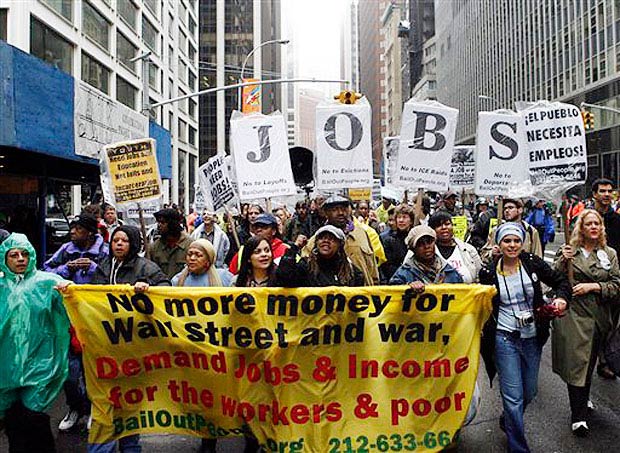
San Francisco Labor Council Endorses April 10th March for Jobs!!!!!!!!!

San Francisco Labor Council Resolution – Adopted Feb. 8, 2010

Commemorate the 75th anniversary of the WPA on April 10, 2010!

We need the same kind of bold sweeping public jobs program today!

Whereas, 75 years ago, on April 8, 1935, Congress passed legislation creating the largest public works program in U.S. history. The Works Progress Administration (WPA) created 8.5 million jobs during the Depression of the 1930s; and

Whereas, organized labor and all working people and communities need to mark the 75th anniversary of the creation of the WPA by telling the government that today's jobless crisis is as bad today as it was back then. We need the same kind of bold, sweeping jobs program that the people demanded in the 1930s; and

Whereas, Martin Luther King Jr. dedicated the final months of his life to starting a movement for the right of all to a job or a guaranteed income – and we need that movement now more than ever; and

Whereas, what we have now is at best a jobless recovery… an economy based on permanent high unemployment and low wages… a political and economic system that provides trillions of $ for Wall Street, and trillions of $ for war but nothing for large numbers of workers and the poor, who are facing joblessness, foreclosures, evictions, layoffs, low wages, hunger and homelessness; and

Whereas, there are more than 20 million unemployed and underemployed people in the country today. We need a real WPA-type program that is big enough to ensure that those who need work get work -- work that is socially useful and paying union wages and benefits – a real jobs program fully funded by the government; and

Whereas, a national labor/community protest will take place on Saturday, April 10, 2010 in Washington, D.C., commemorating the 75th anniversary of the WPA and demanding enactment of a similar bold, sweeping public jobs program today; and


Whereas, the issue of jobs is on the front burner: all it needs is a flame. The April 10th commemoration of the WPA’s 75th anniversary is consistent with the AFL-CIO’s 5-point Jobs Plan. April 10th would be a great stepping stone for a possible labor-led Solidarity Day III march on Washington in the fall of 2010, demanding that a real jobs program like the WPA be enacted today; therefore be it


Resolved, that the San Francisco Labor Council endorse the April 10, 2010 national demonstration in Washington DC, commemorating the 75th anniversary of the WPA, part of the largest public works program in history, which created 8.5 million jobs during the Depression of the 1930s, and demanding enactment of a similar bold sweeping jobs program today;


And be it further resolved, that copies of this resolution be sent to Bay Area labor councils, California Labor Federation, Change to Win, the AFL-CIO and key community allies, urging adoption.


Resolution adopted by the San Francisco Labor Council, February 8, 2010, in San Francisco, California, by unanimous vote.

Sunday, February 7, 2010

Abayomi Azikiwe on Russia Today

BANGLADESH: Convention offers revolutionary view of underdevelopment


PART 1

By Sara Flounders
Dhaka, Bangladesh
Published Feb 7, 2010 7:54 PM

More than 10,000 people gathered under a sea of red flags to open the First Convention of the Socialist Party of Bangladesh, and then held a militant mass march through Dhaka’s crowded streets. Hundreds of nationally elected delegates and many thousands of participants attended the Dec. 30-31 Convention of the SPB, which was formed in 1980. They presented a powerful challenge to the Western corporate media’s view of Bangladesh.
WW photos: Sara Flounders

Almost the only things we ever hear in connection with Bangladesh are that it is hopelessly poor, densely populated and underdeveloped. But whenever revolutionary forces are organizing in the thousands and tens of thousands with anti-imperialist fervor and a clearly focused Marxist perspective of their own problems, they make a contribution to the understanding of the world movement. This can combat corporate media misinformation and imperialist stereotypes.

The Socialist Party of Bangladesh has 40,000 announced members nationally. The party has also helped to develop a number of mass organizations such as a Socialist Workers Front, a Socialist Agricultural and Peasant Front, a Socialist Women’s Forum, a Progressive Teachers Forum and a very large and active Socialist Student Front. These organizations involve tens of thousands of additional activists.

The Socialist Student Front has announced a major event in mid-March to celebrate the 25th anniversary of its founding. Tens of thousands of students from all the universities and many high schools are expected to attend. It is waging a giant campaign to protest cuts and deterioration of education.

In a country with 60 percent illiteracy, with millions of landless peasants and millions of workers surviving in the most desperate slums, many of the students come from a more privileged background. Students in Bangladesh have a revolutionary tradition and have gone into the streets again and again. For decades the most revolutionary-minded student activists have become determined fighters for the working class.


Communism, socialism and revolutionary ideas are still a strong force throughout the Indian subcontinent. Especially in Bengal, East and West, communist ideas have a great support among the masses, among the intellectuals and middle class. There are a number of left parties in Bangladesh, including some reformist Marxist parties that hold elected office in parliamentary coalition governments of the bourgeois state. The SPB has sought to be a revolutionary challenge, not just a parliamentary opposition.

International guests included representatives from the United Communist Party of Nepal-Maoist, the Sri Lankan New Democratic Party, the Socialist Unity Center of India, the ambassador of the Democratic Peoples Republic of Korea, and Workers World Party and the International Action Center in the U.S.

The SPB encourages mutual respect, discussion and unified action or united front actions among the many left parties in Bangladesh. The day after the completion of their convention the Socialist Party sponsored a wide-ranging discussion and question and answer session with the international guests who attended their convention and the leadership of more than 10 left parties, along with independent intellectuals, journalists, filmmakers, Marxist economists, etc. — about 150 people in all.

Many guests remarked about how important it was to have these political discussions. The questions to the delegates from the U.S. concerned the nature of the global capitalist crisis and how intractable it is, the impact of ever expanding U.S. militarism, and why President Barack Obama has continued Bush’s imperialist wars.

In India and in Bangladesh as in Europe some socialist and communist parties have entered bourgeois coalition governments to administer the capitalist state. Always on the agenda is a discussion on the nature of the state in underdeveloped and formerly colonized countries and the role of revolutionary forces.

For the representative from Sri Lanka the participants asked about the debacle just experienced by the Tamil Tigers and of the representative from Nepal about the coming showdown with the government which, backed by India and the U.S, is threatening them with a similar fate. State power is a burning and immediate question on the Indian subcontinent.

Imperialist underdevelopment, socialist solutions

In two documents, the Conveners’ Report of the First Convention and the Thesis on the International Situation, presented in preparation for the First Convention, the SPB gave their view of the international situation politically and the global capitalist crisis that is wreaking havoc on a global scale.

The Convention documents contained serious thinking on the problems facing Bangladesh now. They took up the chaos, lack of planning and profiteering at every level of the capitalist market and the intentional underdevelopment imposed by U.S. imperialism through its banking system, the World Trade Organization, the International Monetary Fund and the World Bank.

As with so many other countries in Asia and Africa, Bangladesh is deliberately kept underdeveloped, dependent and poor. It is used as just a source of cheap labor by U.S. and British policy and increasingly now by Indian capitalists.

The structural adjustments imposed on Bangladesh led to the forced closing of many domestic industries in order to reorient the economy to cheap labor on imported fabric that is exported as garments. These policies have made Bangladesh much poorer. One leader of the SPB stressed again and again in every conversation, “All Western ‘help’ is designed to make us helpless.”

Poverty and unequal distribution in Bangladesh have grown far worse in recent decades. Almost 80 percent of the population is still peasant. But landlessness among the peasantry has grown drastically from 20 percent landless at the time of independence in 1971 to 70 percent of the peasant population reduced to day laborers and indebted sharecroppers without land today.

In a country of 150 million people, 90 million live on the edge of starvation. Millions of workers are forced to go abroad to send home survival remittances.

The SPB explains that the country is fabulously rich in fertile land and a 12-month growing season. Yet more than half the population is seriously malnourished. Though Bangladesh has oil, gas, coal, iron and other minerals, it is denied modern technology and efficient distribution. It is capitalist chaos at its worst.

The SPB provided guests with a great deal of political information, along with an analysis of the many problems facing the country. Each analysis was infused with revolutionary optimism and determination to organize the most desperately poor workers and millions of landless peasants to step into a historic role of challenging capitalist chaos and imperialist domination.


Next, a first-hand view of the struggle in Bangladesh.


Articles copyright 1995-2010 Workers World. Verbatim copying and distribution of this entire article is permitted in any medium without royalty provided this notice is preserved.


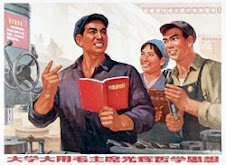
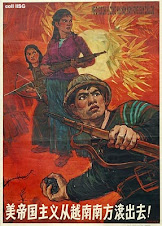
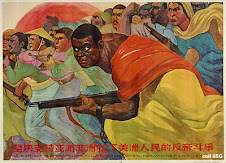
Gallery of Social Realist Paintings: A Reason To Visit The Post Office


Video: Larry Hales on Haiti


Video: Julie Fry on Socialism, Revolution, and Socialist Countries


Saturday, February 6, 2010

Racist, Anti-Poor Insults aim to split the working class

By Caleb T. Maupin
Published Feb 6, 2010 8:35 AM

South Carolina Lt. Gov. Andre Bauer recently made outrageously racist and anti-poor remarks at a town hall meeting of his Republican supporters.

In a statement reminiscent of the Jim-Crow-era South, Bauer equated government school lunch subsidies for poor children with “feeding stray animals.” The reason he gave was “Because they breed. You’re facilitating the problem if you give an animal or a person ample food supply,” and so, “you’ve got to curtail that type of behavior.” (McClatchy Newspapers, Jan. 23)

Bauer made these highly offensive remarks while making the case for abolishing school lunch programs. At this time of worsening economic crisis, these programs are depended on more than ever by millions of low-income children across the country.

His words show utter contempt for poor people, as South Carolina’s jobless rate has risen to 12.6 percent. (bls.gov)

Bauer’s remarks were also an appeal to his Republican base in order to try to win support for his gubernatorial campaign on the most bigoted and reactionary basis.

Bauer is a wealthy, privileged individual. In 2006, he suffered a minor injury when the small plane he owned and piloted crashed. Later that year, he was not even issued a warning citation after being caught driving more than 100 mph in his state-issued car. He told the police officer who pulled him over that he might have a gun. Still, no arrest. (wistv.com, March 28, 2006)

Bauer’s remarks exemplify a common pattern of racist, right-wing rhetoric. In the 1980s, former President Ronald Reagan falsely alleged that “Cadillac welfare mothers” lived in luxury at the taxpayers’ expense.

Such lies paved the way for ex-President Bill Clinton’s 1996 so-called “welfare reform” act, which shattered countless families and cast many into extreme financial insecurity, many of whom have never recovered.

The racist term “Cadillac welfare mothers” was used by right-wing politicians and demagogues to whip up attacks against poor and oppressed women and single mothers. Those living in poverty in the United States, including those who receive public assistance, barely have enough food or livable housing or any other of life’s necessities. None has lived anywhere near a life of luxury.

By making these remarks, Bauer aimed to divide white workers from members of oppressed communities, and to exacerbate racism on the part of whites to try to prevent class unity from developing during this economic crisis.

Southern capitalists and their representatives have used this strategy for decades; they have resorted to fomenting racist divisions to divide poor and working people.

As Sam Marcy pointed out in his book, “The Klan and Government: Foes or Allies?” the Ku Klux Klan functioned as a state-sponsored organization which was used to whip up impoverished white workers against African-American people, and whose purpose was also to commit acts of racist terror and violence against oppressed people and their allies.

The last thing that Lt. Gov. Bauer and his allies of capitalist-class bankers and corporation owners want is for workers and oppressed people to join forces and fight against the rich and powerful.

If Bauer knows the history of his state, he can recall that during the Great Depression, under the leadership of communists in the Trade Union Unity League, the National Textile Workers Union was formed and built Black and white unity.

In 1934, when 400,000 textile workers, African-American and white, went on strike nationwide demanding a better life for all, the majority of textile workers in South Carolina joined in.

Ibra C. Blackwood, then the governor of South Carolina, moved to repress the strike. He called on “all good citizens” to join with the National Guard and attack the strikers under orders to “shoot to kill.” Six strikers were shot dead, following orders from the governor on behalf of the capitalist class.

Bauer and the members of his class know that as conditions worsen for working people, misery and, along with it, hatred will grow for the capitalist system. They know this will inevitably translate to a will to fight back.

When workers and oppressed peoples unite in struggle, they are a strong force, strong enough to win victories. The capitalists know and fear this.

Articles copyright 1995-2010 Workers World. Verbatim copying and distribution of this entire article is permitted in any medium without royalty provided this notice is preserved.

Walking While Black in Pittsburgh

By Sean Schafron
Pittsburgh
Published Feb 4, 2010 10:11 PM

Around 11 p.m. on Jan. 12, another tragic incident demonstrated the racist establishment’s brutal punshment of the crime of “walking while Black” in Pittsburgh.

Jordan Miles, an 18-year-old viola player and honors student at the prestigious Creative and Performing Arts High School (CAPA), was walking from his mother’s home to his grandmother’s home where he frequently stayed, when he was inexplicably and brutally attacked by three white Pittsburgh police officers.

According to the police report, Miles was standing against a building “as if he was trying to avoid being seen.” The police said they observed something under the young man’s jacket which they thought to be a gun but turned out, according to their report, to be a bottle of Mountain Dew.

Miles maintains he had nothing in his jacket and seldom even drinks the beverage. He relates a different and more terrifying story. As he was walking he noticed a white car with three men inside. They jumped out of the vehicle and shouted, “Where’s the money?” “Where’s the gun?” and “Where’s the drugs?” Afraid of being robbed, Miles turned towards his mother’s home when he slipped and fell on an icy sidewalk.

Before he could get back up, Miles reported, “That’s when they started beating me, punching, kicking me, choking me.” It wasn’t until about 15 minutes later, when uniformed officers arrived in a police van, that Miles realized he was being arrested. The attackers never identified themselves as police, and when he was handcuffed Miles assumed he was being abducted.

The officers have been identified as Richard Ewing, David Sisak and Michael Saldutte. All three failed to appear at Miles’ Jan. 18 hearing on charges of resisting arrest and aggravated assault.

Miles had no criminal record prior to the attack.

Pictures taken and released by his mother, Terez Miles, show the young man’s face covered with bruises, with his right eye swollen shut and a bald spot where officers tore dreadlocks from his head. “My son is 150 pounds and 5-foot-6. There was no need for this degree of violence and brutality for someone of this stature,” she said. He was treated twice at West Penn Hospital for his injuries.

The media picked up on this horrific story, prompting Pittsburgh Mayor Luke Ravenstahl to state, “The incident was very troubling to me, and we’re taking it very seriously.” Ravenstahl also told reporters, “It seems as if there was a tremendous amount of force used.” However, not only have the offending thugs not been fired or even suspended, they were merely taken off of plainclothes duty and reassigned in uniform.

With nationwide attention increasing, the FBI opened a fact-finding investigation to determine if Miles’ civil rights were violated.

The public outrage against this crime has been swift. On Jan. 26 about 60 CAPA students were joined by concerned residents and activists on a march through downtown Pittsburgh chanting, “Justice for Jordan!”

Outside Pittsburgh City Council chambers, Black Political Empowerment Project Director Tim Stevens spoke passionately as many of Miles’ schoolmates and others pushed back tears. “I cannot fathom how the Pittsburgh police could, in any reasonable way, defend the beating, stomping, choking and kicking of an unarmed, 5′6″, 150-pound teenager by three armed police officers. Simply moving the police officers from their former undercover status to uniform status does not properly handle this very troubling situation. These officers are still on the street to possibly brutalize other innocent, nonsuspecting citizens.”

Believing her son was racially profiled, Miles’ mother may file a civil rights lawsuit once the criminal case is resolved. Pittsburgh’s NAACP chapter has called for the three brutal officers to be fired and for all charges against Miles to be dropped. Chapter President M. Gayle Moss said, “He had robbed no one — no bank, no establishment, hijacked no car or caused anyone any harm. He was simply walking while Black.”
Articles copyright 1995-2010 Workers World. Verbatim copying and distribution of this entire article is permitted in any medium without royalty provided this notice is preserved.

Friday, February 5, 2010

Hilda Bell Roberts, Anti-Fascist


Hilda Bell Roberts, born in 1915 and raised in Philadelphia of immigrant parents, a lifelong progressive activist and a volunteer nurse in the Abraham Lincoln Brigade during the 1936-1939 Spanish Civil War fighting against fascist dictator Francisco Franco, passed away in the San Francisco Bay Area last Sept. 23. On Jan. 29, in her honor the Berkeley Fellowship of Unitarian Universalists held a special showing of the Academy Award-nominated documentary film, “Forever Activists: Stories from the Veterans of the Abraham Lincoln Brigade.”

Following the film there was a special advance showing of a portion of a 1986 interview with Hilda from the Abraham Lincoln Brigade archives. Hilda, who lived in Berkeley, has already been greatly missed at local progressive rallies and demonstrations, which she had continued to participate in until the very last few months of her life, despite suffering from a very rare form of blood cancer that affected her mobility and ability to remember but against which she waged a courageous struggle.

Hilda Bell Roberts, ¡Presente!

— Report and photo by Joan Marquardt